Most people get their first yellowjacket sting in late July or August, not because a new colony appeared overnight, but because the one that’s been building since April finally has thousands of workers in it. That shift in population is what changes the behavior. A colony with 50 workers has very little to protect. A colony with 5,000 does, and it acts accordingly.
Yellowjacket season in South Carolina is a progression, not an event. Understanding where a nest is in that progression is the difference between catching a problem early and dealing with a fully mobilized colony at peak summer heat.
Yellowjacket Season in South Carolina
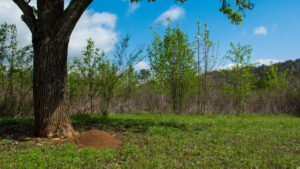
In Upstate South Carolina, yellowjacket queens come out of overwintering in late February or early March. Greenville County’s mild winters mean some queens emerge earlier than they would further north, though most nest-building activity doesn’t become visible until April. Through spring, the colonies stay small enough that most homeowners in Simpsonville and Greer never notice them, even if there’s a ground nest ten feet from the back patio.
That changes in July. The colony hits its fastest growth phase right when outdoor activity is highest in the Upstate: cookouts, yard work, kids playing in grass. The combination of a rapidly expanding population and increased human traffic near nest sites is what produces most of the stings we get called about.
How Nest Populations Build Through Summer
A queen starts the season completely alone. She constructs the first cells, lays the first eggs, and raises the first workers without any help. Once those workers emerge, they take over foraging and nest expansion, and the colony’s growth accelerates. UC IPM documents yellowjacket colonies that reach 1,500 to 15,000 workers by peak season depending on species and local conditions. South Carolina’s warm summers extend the active season longer than most of the country. Upstate colonies have more time to build before fall shuts them down.
What that growth looks like across the season:
- Spring colonies hold fewer than 50 workers and rarely get noticed
- By early July, the population has climbed into the hundreds
- From late July through August, worker counts range from 1,500 into the thousands
- September nests are at maximum size and focused on producing new queens and males that will overwinter
Why Late Summer Nests Sting More
The spike in stings that happens every July and August isn’t random. UC IPM’s pest notes on social wasps put it directly: defensive behavior increases as the season progresses and colony populations become larger. A bigger colony has more to protect and more workers available to do it. The threshold for triggering a defensive response also gets lower as the season goes on.
There’s a food factor too. Spring colonies forage mostly for protein because they need it to feed developing larvae. By late summer, the foraging pattern shifts heavily toward sugars and carbohydrates to fuel the adult workers. That’s what brings yellowjackets to open drinks, uncovered food, and trash cans near outdoor gathering spots in the Upstate.
What Attracts Yellowjackets to Your Property

Open food and drink is the most direct draw, but other conditions make yards more attractive to foraging workers:
- Uncovered garbage cans or compost bins close to areas where people spend time outdoors
- Fallen fruit under trees that ferments as it sits
- Vibrations near a ground nest from mowing, digging, or foot traffic overhead
- Pet food left outside, especially anything wet or protein-based
Knowing the attractants matters because a yard that pulls in high forager traffic is also a yard where a ground nest is more likely to go unnoticed until someone steps on it.
Yellowjacket vs. Wasp: How to Tell Them Apart
Yellowjackets and paper wasps both show up around Greenville County homes in summer, and they’re worth telling apart because their nesting habits are different. Yellowjackets are stockier, with bright yellow-and-black banding and no obvious pinch at the waist. Paper wasps are noticeably slimmer, with a pinched abdomen and coloring that usually mixes in brownish-orange.
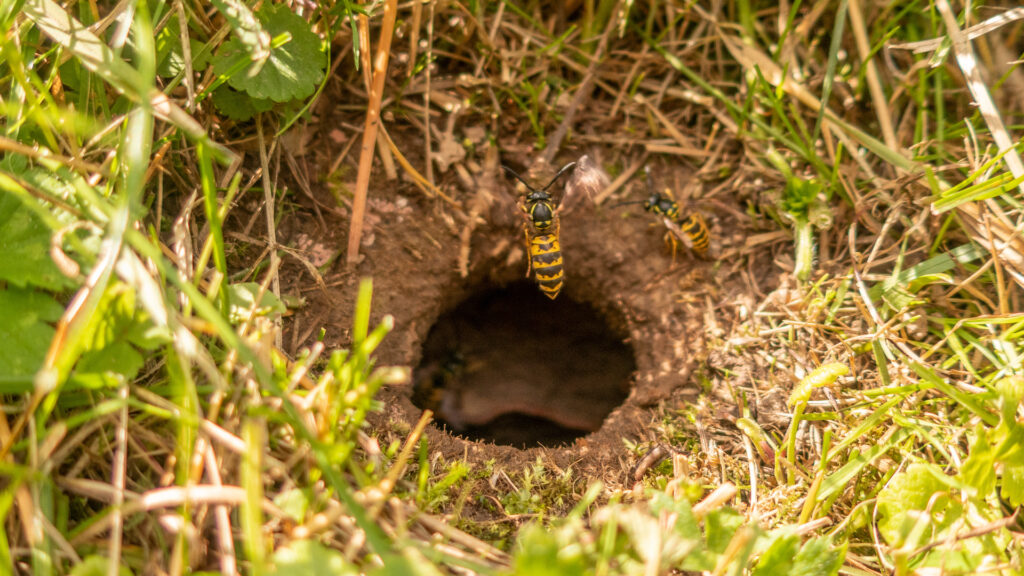
Paper wasps build open, umbrella-shaped nests under eaves, porch ceilings, and deck railings. You can see the individual cells. Yellowjackets build enclosed nests, usually underground in abandoned rodent burrows, inside wall voids, or in hollow logs and stumps. If you can see the nest structure, it’s almost certainly a paper wasp. Workers going in and out of a hole in the ground or a gap in your siding are a stronger sign of yellowjackets.
Where Yellowjackets Nest in the Upstate
Ground nests account for most of the calls we get from homeowners in Greenville, Spartanburg, and Anderson counties. Old rodent burrows are a common starting point; they’re already excavated and the soil is loose enough to expand easily. Wall void nests are less common but harder to address, especially when the colony has been there long enough to build a structure several feet wide inside the wall. By late summer, a wall void nest can have tens of thousands of workers and no obvious sign from the outside except a steady line of traffic near a gap in the trim or siding.
Treating a Nest Yourself Usually Makes It Worse
Store sprays can reach the entrance of a ground nest, but they rarely reach the colony. Yellowjacket tunnel systems extend well below the surface, and most ground nests have chamber configurations that push the main population away from the opening. Aerosol products kill the workers near the entrance. The deeper colony reorganizes and activity resumes within a day or two.
Our post on why you shouldn’t try to kill yellowjackets yourself gets into the specifics, but the short version is this: an agitated colony at peak summer size can mobilize hundreds of workers faster than most people can react, and insect allergies make even one or two stings a serious risk.
What Professional Nest Treatment Covers
Professional treatment gets product into the tunnel system, not just near the opening. For ground nests, timing matters: late evening treatments work better because foraging workers have returned and the colony is less active. For wall void nests, the approach depends on how deep the void runs and where the nest mass is sitting. We look at each situation before recommending anything, because a partially treated late-summer colony with thousands of workers is more dangerous than an untreated one.
Call Scout’s Pest Control
Yellowjacket season in Upstate South Carolina is at its most intense right now. If you’ve found a ground nest in your yard or you’re watching workers go in and out of a gap in your siding, the colony is only going to grow larger. Call us at 1-864-469-4999, or reach out through our residential pest control page. We serve homeowners across the Upstate, including:
- Anderson, SC
- Belton, SC
- Clemson, SC
- Duncan, SC
- Easley, SC
- Five Forks, SC
- Fountain Inn, SC
- Gray Court, SC
- Greenville, SC
- Greer, SC
- Iva, SC
- Laurens, SC
- Lyman, SC
- Mauldin, SC
- Oconee County, SC
- Pickens, SC
- Piedmont, SC
- Simpsonville, SC
- Six Mile, SC
- Spartanburg, SC
- Taylors, SC
- Townville, SC
- Travelers Rest, SC
- Williamston, SC
- Woodruff, SC